Whether it's automotive parts, electronic equipment, medical consumables, or plastic casings, as long as you need to make permanent marks on the products - such as brand logos, QR codes, production dates, batch numbers, or anti-counterfeiting marks, precise scales - our precise laser engraving service (which mainly uses fiber laser technology) can meet your needs.
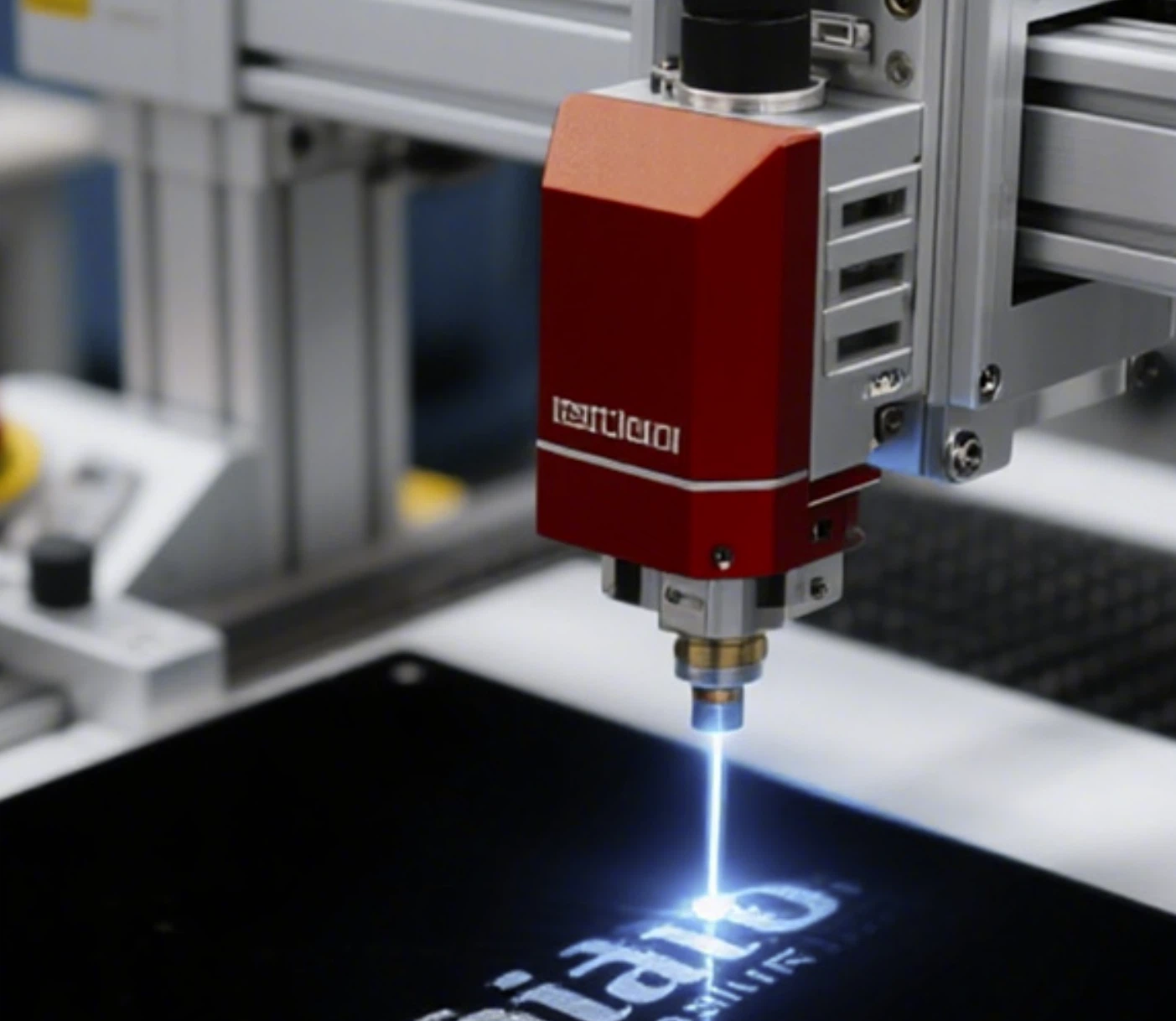
Its working principle involves the laser vaporizing the material‘s surface layer (e.g., paint film) to expose the base material. This method is commonly applied to painted plastic/metal parts (such as mobile phone logos,Button Identifier ).
The process consists of five steps: material pre-treatment (cleaning, sandblasting), pattern design import, parameter adjustment (power: 5-100W, speed: 100-1000mm/s, etc.), positioning and engraving, and post-processing inspection. It can process nearly all solid materials, including plastic, metal, glass, and wood, with a precision of 0.01mm. It supports both mass production and personalized customization. However, the engraving depth is mostly no more than 1mm, and transparent materials require pre-treatment to produce clear marks.
Targeted Risk Control (Data-driven Metrics)
Hard standards for laser parameters must be established: real-time laser power monitoring (calibrated with a power meter every 2 hours, fluctuation ≤±5%); daily calibration of focusing lenses (offset ≤0.01mm). Supporting material-specific inspections include: 100% stress testing for brittle materials (e.g., glass) with stress values ≤5MPa; 3% sampling of metal parts per batch for microhardness testing (hardness variation ≤10%). These measures eliminate engraving deviations (depth difference ≤0.05mm) and hidden damage caused by unstable energy.
Full-process Traceability (Data Records)
Pre-production: Provide material batch reports (laser absorption rate test error ≤2%, material purity ≥99.5%) and parameter-signed samples (power/frequency deviation ≤±3%). In-production: Generate hourly inspection data (engraving position offset ≤0.03mm, CCD positioning calibration record deviation ≤0.005mm). Post-production: Issue sampling test reports (no fading after 24h at 120℃, no wear after 500 alcohol wipes, pass rate ≥99.8%). All records are linked to equipment IDs (e.g., laser engraver ID) and operator codes, supporting traceability inquiries for 1 year.
Standards and Safeguards (Data-driven Commitments)
Clear acceptance criteria: engraving depth deviation ≤0.05mm; no burrs under 100x magnification (burr length ≤0.002mm); 100% pattern integrity (no broken strokes/blurring). Abnormality handling: 100% isolation rate for non-conforming products, rework qualification rate ≥95%. Quality commitment: 100% coverage of rework costs caused by laser engraving defects, with a replacement lead time ≤48 hours.

How to Achieve High-Quality Engraved Products
Equipment and Parameter Calibration
-
Regularly calibrate the laser head's focusing lens: Ensure precise laser spot focusing (smaller spot diameter corresponds to higher precision). Clean the focusing lens weekly to prevent dust from interfering with energy distribution.
-
Test and standardize material parameters: For different materials (e.g., ABS, stainless steel, acrylic), pre-test the optimal combination of "power, speed, and frequency" (Example: ABS plastic engraving — 30W power, 500mm/s speed, 50kHz frequency to avoid burning) and establish a parameter database.
-
Inspect motion system precision: The servo motor's repeat positioning accuracy must be ≤0.005mm. Lubricate the guide rails regularly to prevent engraving pattern deviation.
-
Non-metallic materials (plastics, wood): Clean surface oil stains and dust (wipe with alcohol) before processing to avoid white spots or shadows after engraving.
-
Metallic materials (stainless steel, aluminum alloy): For clear markings, perform sandblasting first (to increase surface roughness) followed by engraving — this enables more thorough interaction between the laser and the material, resulting in sharper patterns.
-
Avoid incompatible materials: Engraving PVC generates toxic chlorine gas (which is also corrosive to equipment); prioritize replacement with PP/PE/ABS. Glass requires an ultraviolet (UV) laser (low power, high frequency) to prevent cracking.





 WhatsApp Us


 Deutsch
 Français
 Português
 Español
 العربية