We are capable of addressing specific design or production challenges. Should you seek to explore how 3D printing can resolve a particular design or production issue, our consulting team is fully competent to provide assistance. As an engineering team with a combined professional experience of over 10 years, we possess proficiency in both traditional manufacturing and additive manufacturing processes. We will offer professional recommendations on how 3D printing can expand the boundaries of your components in terms of design potential, quality, and performance, or enhance production flexibility and cost-efficiency.
The advantages of 3D printing for plastic products are mainly reflected in the following aspects:
-
High design freedom: Breaking free from the mold constraints of traditional processes like injection molding, it enables the integrated forming of complex geometric structures (such as hollowed-out designs, internal cavities, and irregular curved surfaces) without the need for post-assembly. This makes it particularly suitable for personalized or innovative designs.
-
Rapid iterative validation: Eliminating the need for expensive mold production, the cycle from digital model to physical prototype can be shortened to hours or days, accelerating the processes of product design verification, functional testing, and market feedback.
-
Flexible and efficient small-batch production: For small-batch orders (ranging from dozens to hundreds of units), 3D printing avoids mold investment costs and lowers production thresholds, making it especially ideal for customized needs or trial production stages.
-
Wide material adaptability: It supports a variety of plastic materials (e.g., ABS, PLA, nylon, TPU) to meet different performance requirements (such as strength, toughness, temperature resistance, and flexibility). Some materials can even achieve physical properties comparable to those of products made by traditional processes.
-
Strong cost controllability: In small-batch production, it eliminates mold design and manufacturing costs. Additionally, its high material utilization rate (near-net shaping, reducing waste) gives it a more favorable overall cost advantage.

The advantages of 3D printing in the manufacturing of metal products:
-
Most notably, it boosts heat exchange efficiency dramatically. Using Selective Laser Melting (SLM), it creates cooling channels that "conform equidistantly" to part contours—CAD-defined 3mm uniform gaps increase heat exchange area by 30%–50%. This enhances turbulence, lifts heat transfer coefficient by over 20%, and cuts injection mold cooling cycles by 20%–40%.
-
Equally valuable is its structural design flexibility. Special-shaped internal channels (bifurcated, spiral, etc.) adapt to complex heat dissipation demands. For varying wall thicknesses (e.g., 3mm to 10mm transitions), channel diameters (φ2–φ8mm) adjust dynamically for "on-demand temperature control." 1–3mm gradual junctions prevent cracking and ensure steady heat transfer.
-
These embedded channels go beyond mere "shape-following." Through integrated material-structure-performance design, 3D printing solves traditional manufacturing’s trade-off between thermal precision and structural complexity, supporting high-end equipment’s lightweight, precision and efficiency goals.

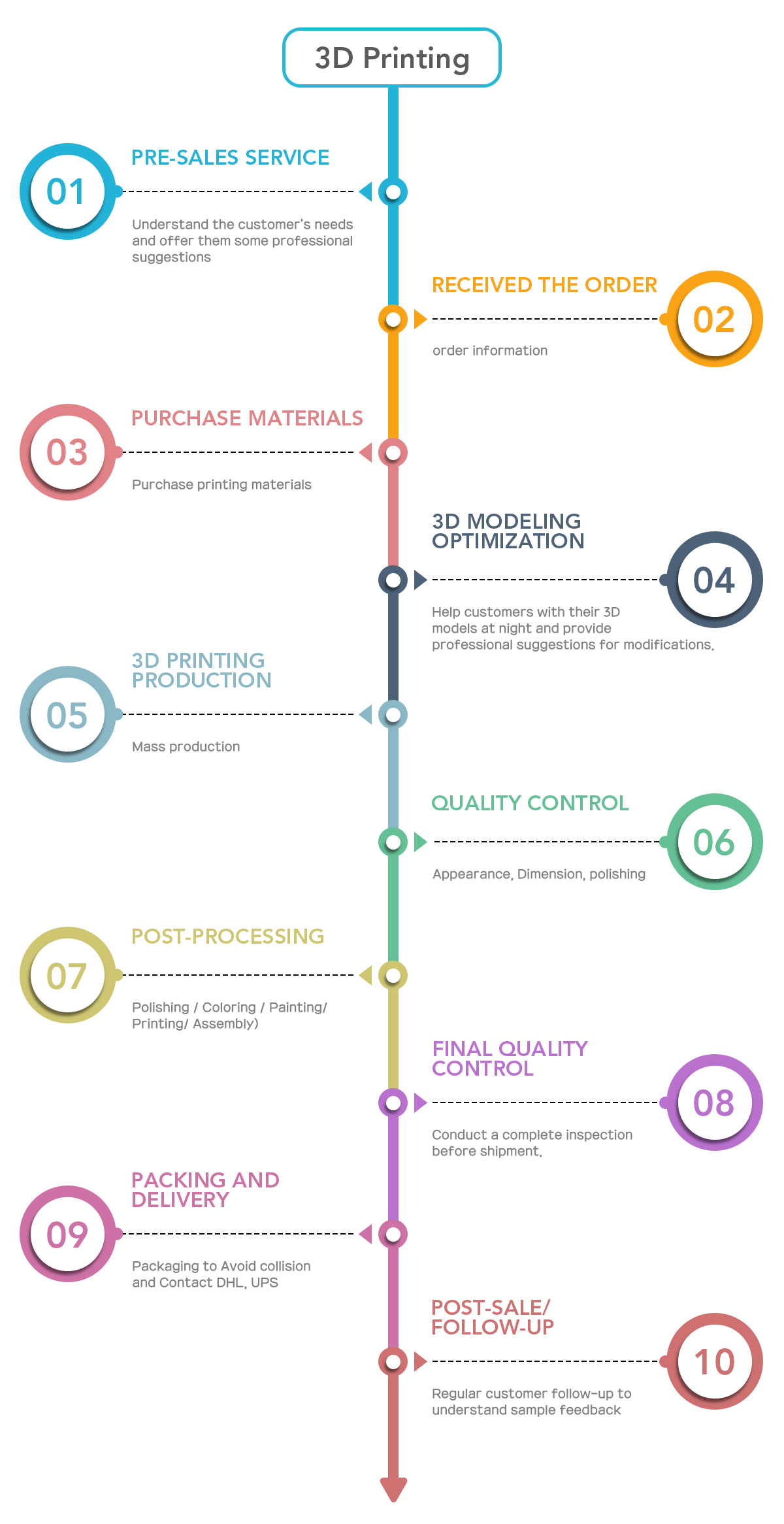
Operating Procedures:





 WhatsApp Us


 Deutsch
 Français
 Português
 Español
 العربية