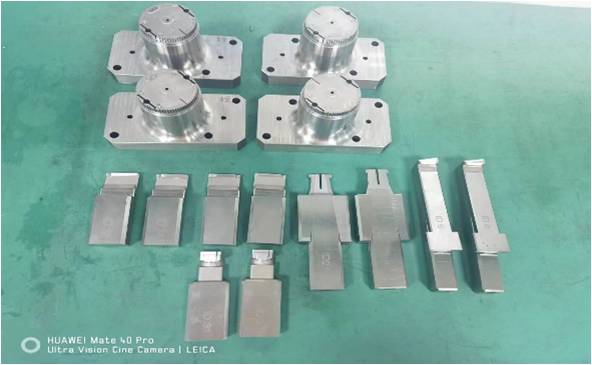
Core insert, material (H13), hardness (HRC48-50), resistant to cold and hot fatigue (not prone to cracking under repeated temperature changes), resistant to forming friction and wear, suitable for mass production, is a commonly used base material for injection molding / die casting molds.
Processing accuracy: The maximum tolerance can typically reach ±0.01mm, and a data report (CMM) will be provided.
Surface: (SPI-B3): Polished with 320-grit sandpaper, the surface has a slight sheen (roughness Ra ≈ 0.28 - 0.32 μm), and can cover up the machining marks.
Lead time 3 days.
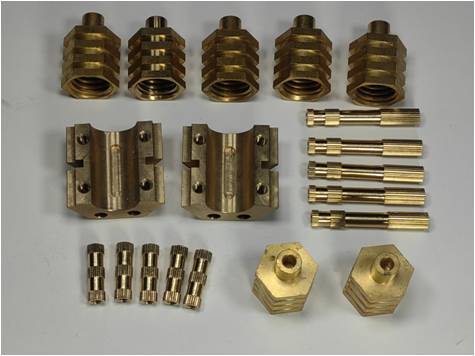
Brass parts and screw-inserts
Types: Include brass screw insert (with knurled/stepped structures), brass bushings, brass connection blocks, and brass locating pins.
Material: Typically brass (e.g., H62/H65), featuring good electrical conductivity, wear resistance, and machinability.
Functions: Used for fastening, transmission, positioning, or electrical connection in mechanical structures, suitable for high-precision assembly scenarios.
Applications: Commonly found in transmission/connection systems of automotive parts, electronic devices, and precision instruments.
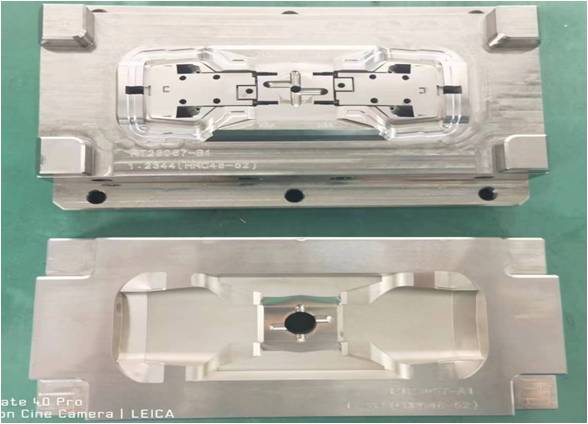
Precision CNC Parts (core and cavity)
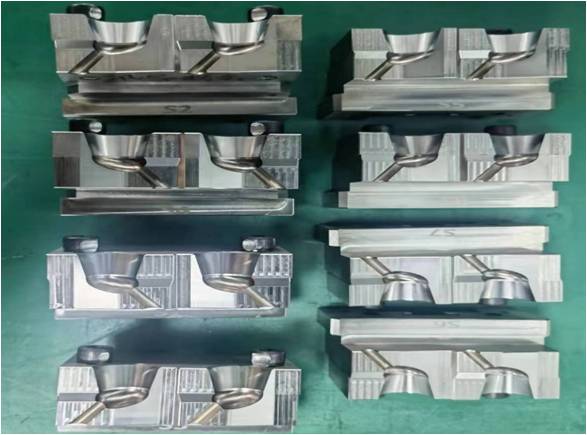
Core and cavity: material (H13), hardness (HRC48-52), resistant to cold and hot fatigue (not prone to cracking under repeated temperature changes), resistant to forming friction and wear, suitable for mass production, is a commonly used base material for injection molding / die casting mold.
Cooling line drilling / tapping
CNC Rough machining
Hardening
Finish machining and Wire cutting all holes
Surface finish (SPI-B3)core and cavity
Cavity texturing VDI-30
Maximum tolerance ±0.005mm~±0.01mm, with a data report (CMM).
Precision CNC Parts (inserts)
Wire cutting + Precision grinding process
Material (H13): HRC 50-54
making: (Wire cutting + Precision grinding), enabling fast mass production.
Tolerance: Controlled at -0.01mm (negative tolerance), a precision-level dimension requirement that ensures tight fitting with the mold
Slider: material (H13), hardness (HRC48-50), Surface nitrogenized up to 60 degrees, with excellent wear resistance. The nitrogenized layer (with a thickness of approximately 0.1 - 0.3mm), resistant to cold and hot fatigue (not prone to cracking under repeated temperature changes), resistant to forming friction and wear, suitable for mass production,
Processing accuracy: The maximum tolerance can typically reach ±0.01mm, and a data report (CMM) will be provided.
Surface: (SPI-B3): Polished with 320-grit sandpaper, the surface has a slight sheen (roughness Ra ≈ 0.28 - 0.32 μm), and can cover up the machining marks.
Precision CNC Parts (croe)
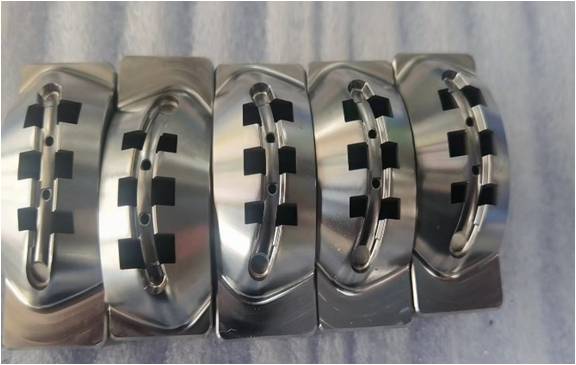
Tooling Core: material (H13), hardness (HRC48-50), resistant to cold and hot fatigue (not prone to cracking under repeated temperature changes), resistant to forming friction and wear, suitable for mass production, is a commonly used base material for injection molding / die casting molds.
Processing accuracy: The maximum tolerance can typically reach ±0.01mm, and a data report (CMM) will be provided.
Surface: (SPI-B3): Polished with 320-grit sandpaper, the surface has a slight sheen (roughness Ra ≈ 0.28 - 0.32 μm), and can cover up the machining marks.
Lead time 3 days.
Precision CNC Parts (Core inserts)
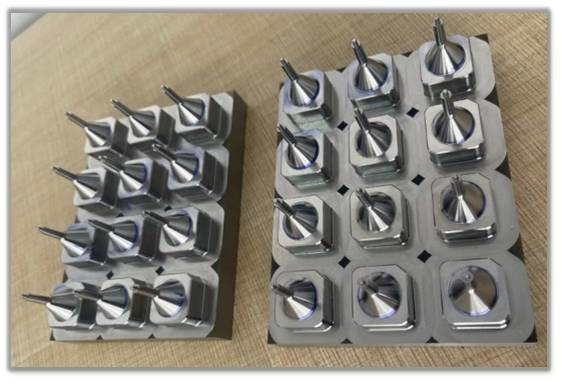
Core insert, material (1.2344), hardness (HRC48-52), resistant to cold and hot fatigue (not prone to cracking under repeated temperature changes), resistant to forming friction and wear, suitable for mass production, is a commonly used base material for injection molding / die casting molds.
Processing accuracy: The maximum tolerance can typically reach ±0.01mm, and a data report (CMM) will be provided.
Surface: (SPI-B3): Polished with 320-grit sandpaper, the surface has a slight sheen (roughness Ra ≈ 0.28 - 0.32 μm), and can cover up the machining marks.
Lead time 3 days.
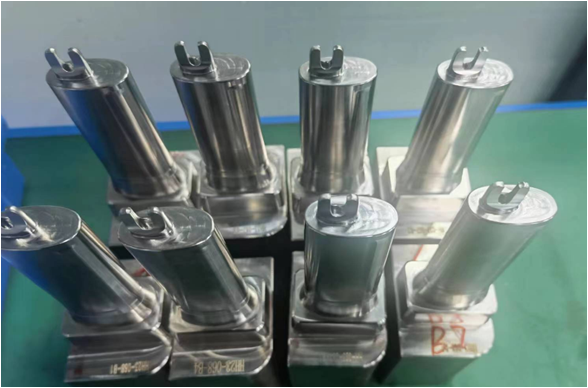
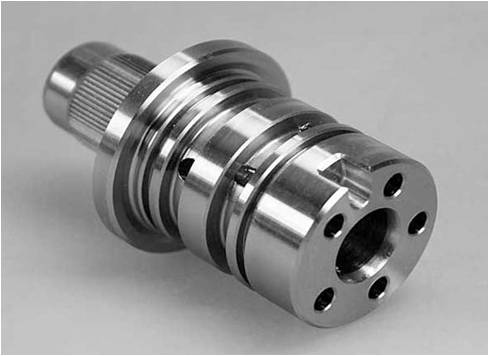
Precision CNC Lathe Parts
Stainless steel (such as 304/316) has moderate hardness but excellent toughness. The high-precision servo system of the CNC lathe combined with carbide tools can well meet the processing requirements, especially suitable for the complex structures of this part such as multi-step outer circles, head embossing, and end holes.
The automated processing of the CNC lathe can ensure batch consistency, and the surface finish of stainless steel (such as Ra0.8μm grade) can be directly achieved through CNC fine turning, reducing the subsequent grinding process.






 WhatsApp Us


 Deutsch
 Français
 Português
 Español
 العربية